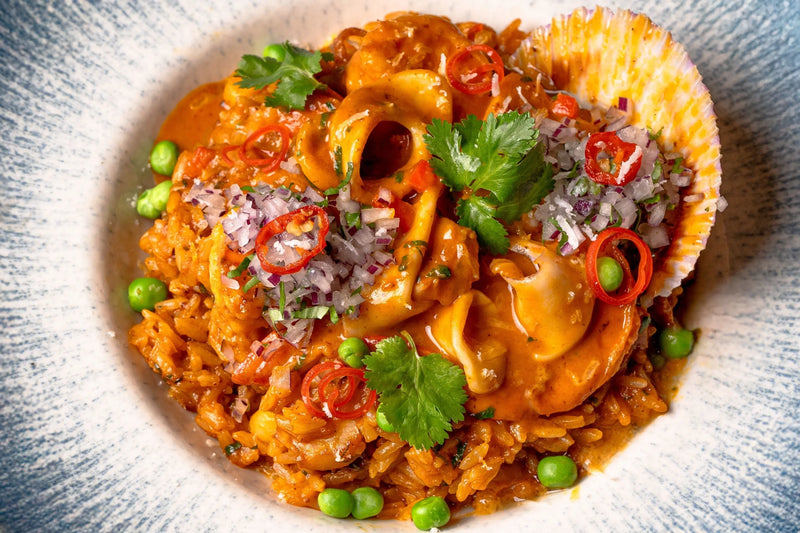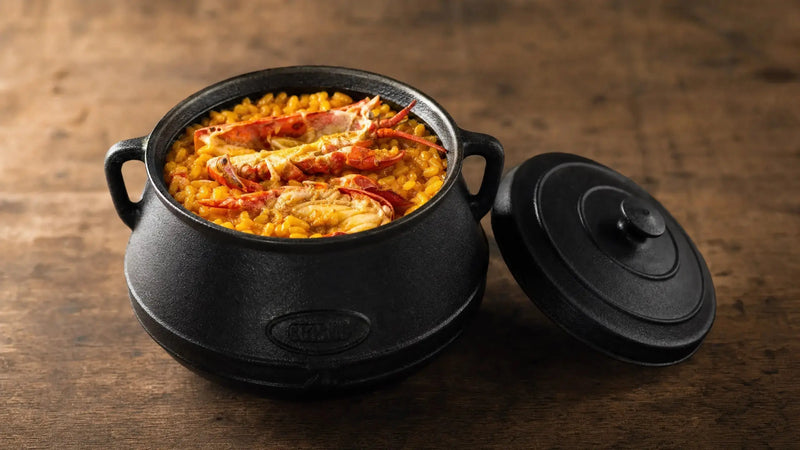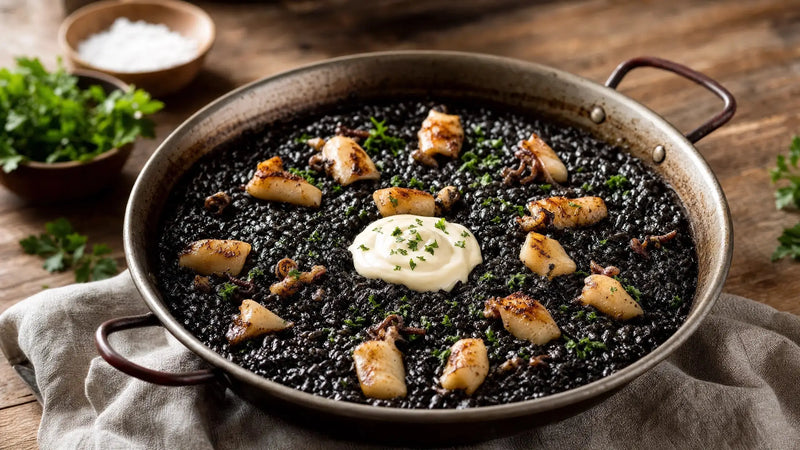




At Escuina we always say the same thing: paella is not a seafood dish, nor a meat dish, nor a vegetable dish. Paella is a rice dish. The rest of the ingredients are there for a single purpose: to flavor the broth that the grain will absorb.
That is why choosing the right variety of rice is the most important decision you will make. Not all rices behave the same way over the heat. Some absorb a lot of flavor but become overcooked in seconds, while others are very resistant but less flavorful.
In this guide we analyze the 5 star varieties grown in the Albufera Natural Park and we explain exactly when you should use each one.
1. Bomba Rice: The life insurance
Bomba Rice is, without a doubt, the most famous and prestigious variety. Its main characteristic is that the grain expands sideways (not lengthwise) when cooked, reaching up to double its size. It is the rice with the greatest resistance to overcooking on the market: it is very difficult for it to become mushy or overcooked. It needs a ratio of 1 part rice to 3 parts broth (or even 3.5) and a cooking time of 18-20 minutes. It is the perfect option for beginners, for soupy or creamy rices, and for restaurants where the rice must wait for a while before being served.
2. Albufera Rice: The perfect balance
Albufera Rice is a relatively new variety, born from the cross between the Bomba and Senia varieties. It has revolutionized haute cuisine because it combines the best of both worlds: the high flavor absorption of the Senia and the resistance to overcooking of the Bomba. With a ratio of 1:3 and a cooking time of 16-18 minutes, it is our absolute favorite for traditional Valencian paella and thin-layer dry rices.
3. J. Sendra Rice (and the Senia family): The flavor sponge
The varieties of the Senia family (such as J. Sendra) are the ones that have traditionally been consumed in Valencian homes. They are short-grain pearlescent rices that act as true sponges: they absorb a much higher amount of flavor than Bomba. Their downside is that they require great precision with the clock and the heat, because they go from raw to mushy in barely two minutes. With a ratio of 1:2.5 and a cooking time of 15-16 minutes, they are ideal for very powerful fish rices such as arroz a banda, when you already master the timing of your paella cooker.
4. Marisma Rice: The creamy texture
Marisma is a variety less known outside of Valencia, but highly appreciated by experts. Its grain is slightly larger and meatier, which makes it exceptional for creamy rices (such as lobster rice or duck rice) and for risottos, since it releases the starch very elegantly.
5. Dinamita Rice (Molino Roca): The chefs' secret
Special mention deserves Dinamita Rice from Molino Roca. It is not a botanical variety itself, but a selection and a unique aging (curing) process in the world carried out by this century-old mill. Being aged, the grain has lost natural moisture, which means it "drinks" much more broth during cooking, absorbing all the flavor of the fumet. It is the rice used by the most avant-garde cooks in Spain when they want to take their paella to a Michelin star level.
Summary Table of Varieties
| Variety | Flavor Absorption | Resistance to Overcooking | Cooking Difficulty | Broth Ratio | Ideal Use |
|---|---|---|---|---|---|
| Senia / J. Sendra | Maximum | Low | Difficult | 1 : 2.5 | Dry rices for experts |
| Albufera | High | High | Medium | 1 : 3 | Valencian paella, perfect balance |
| Bomba | Medium | Maximum | Easy | 1 : 3 - 3.5 | Beginners, soupy rices |
| Marisma | High | Medium | Medium | 1 : 2.5 - 3 | Creamy rices |
| Dinamita | Extreme | High | Medium | 1 : 3.5 | Haute cuisine, maximum flavor |
At the Escuina Rice Club we only work with single-variety rices with the Valencia Designation of Origin, guaranteeing that all the grains in the package need exactly the same cooking time. Choose yours and light the fire.