


Making paella is, at its core, about controlling the heat. It doesn't matter if you have the best rice from the Albufera or the freshest seafood if the heat isn't distributed evenly across the entire base of the paella pan. The result will be rice that is overcooked in the center and hard at the edges.
Choosing the right burner (or gas paella stove, as we call it in Valencia) is the most important technical decision you'll make. In this article, we explain the differences between the models on the market, what a thermocouple valve is, and how much power you really need.
1. Flat tube or round tube? The key difference
If you look at the catalog of our burners, you'll see that there are two main families. The difference is not aesthetic, but functional.
Traditional burners (round tube): These are the classic burners that have always been around. The gas comes out through holes in the top of the tube. They work perfectly, but they are more sensitive to the wind if you cook outdoors.
High-power burners (flat tube): These are the technical evolution. The gas comes out through the sides of the flat tube, creating a wider, more powerful flame that is more resistant to the wind. They heat up faster and distribute the heat more evenly. If you are looking for professional results, this is your option.
2. Cooking indoors vs. outdoors: The thermocouple valve
This is the golden rule of rice safety: never use a standard paella stove indoors.
If you are going to cook in an enclosed kitchen, a glass-enclosed balcony, or a garage, regulations require the burner to have a thermocouple safety valve. This system detects if the flame goes out and automatically cuts off the gas supply in seconds, preventing accidents.
At Escuina, we have a specific line of indoor paella stoves equipped with this technology. If you cook outdoors, standard models are perfectly safe.
3. The relationship between burner diameter and the paella pan
The most common mistake is buying a burner that is too small. The flame must reach the edges of the paella pan so that the rice cooks evenly. As a general rule, the burner should be between 10 and 15 centimeters smaller than the paella pan.
| Burner Diameter | Paella Pan Size | Guests |
|---|---|---|
| 30 cm (1 ring) | 36 to 42 cm | 3 - 4 people |
| 40 cm (2 rings) | 46 to 55 cm | 5 - 8 people |
| 50 cm (2 rings) | 60 to 70 cm | 10 - 15 people |
| 60 cm (3 rings) | 70 to 80 cm | 15 - 20 people |
4. The essential accessories
A burner doesn't work alone. You will need three items that are often forgotten at the time of purchase.
First, the gas regulator: suitable for your type of gas cylinder (butane or propane). In Spain, the standard is the 30 mbar regulator for butane, although professional paella stoves may require 50 mbar.
Second, some legs or a tripod. A good reinforced tripod allows you to level the paella pan perfectly and cook at an ergonomic height.
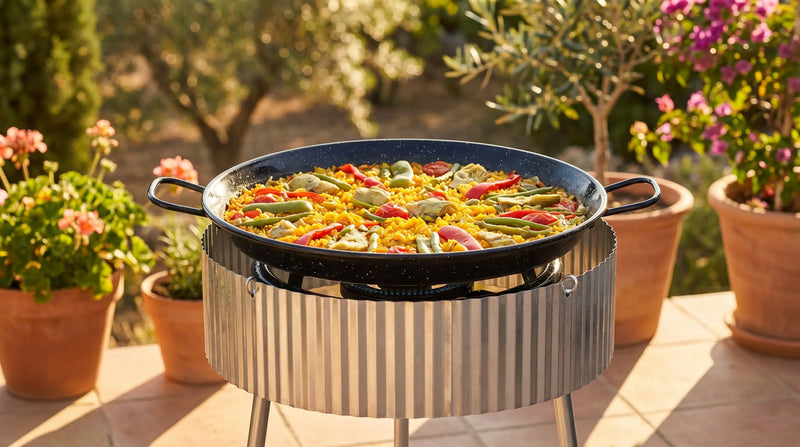
And third, if you cook outdoors, a peripheral windbreak will reduce gas consumption and prevent the wind from diverting the heat.
Ready to master the heat? Find the perfect burner for your rice dishes.
View all burners →